A Dinner With Friends Revealed Qpidcon’s Next Product Opportunity
Building Qpidcon has always started with a simple hypothesis: Your friends know you better than a dating algorithm does.
Instead of swiping through hundreds of strangers, Qpidcon lets friends and family act as cupids and introduce singles they genuinely believe could be a good match.
The first version of the product already supports this behavior. Cupids can add their single friends and introduce two people they know. Singles can add trusted friends and family as cupids, browse singles within those trusted circles, and ask for an introduction.
But recently, a simple conversation over lunch with friends showed me that real-life matchmaking can work in an even more interesting way.
The story of Pepe, Santi and Kata
My friend Pepe has a cousin, Santi, who is single. Our friend Kata also has a cousin who is single. During lunch, they started talking about them. Kata showed Pepe her cousin's Instagram profile. Pepe looked at it and immediately thought: “She could be a good match for Santi.”
So Pepe showed her profile to Santi. He liked what he saw and followed her on Instagram. It was exactly the type of behavior Qpidcon is trying to facilitate. But there was one important difference.
Pepe didn't know Kata's cousin.
He knew Santi.
Kata knew her cousin.
And Pepe and Kata knew each other.
The trust graph wasn't: Santi ← Pepe → Kata's cousin
It was: Santi ← Pepe ↔ Kata → Kata's cousin
That small difference exposed an important limitation in the current product.
What if a cupid only knows half of the match?
Today, Qpidcon works particularly well when one cupid knows two single people and thinks they should meet. But that's not always how matchmaking happens in real life. Sometimes I know someone who would be perfect for your friend. Sometimes you know someone who could be perfect for mine. Neither of us needs to know both singles. We just need to trust each other. That led to a new product hypothesis:
What if cupids could collaborate to find matches for their friends?
Instead of requiring one cupid to know both singles, Qpidcon could connect two trusted social circles.
Introducing “Ask another Cupid for help”
Imagine Pepe opens Santi's profile in Qpidcon.
Instead of only being able to select another single from his own network, he could choose:
Ask another Cupid for help.
Pepe selects Kata and sends her a request:
Pepe thinks you might know someone who could be a good match for Santi.
Kata sees Santi's profile and immediately thinks of her cousin. She proposes her.
Pepe can then see enough of her profile to decide whether he also thinks they could be a good match.
If both cupids agree, each person receives the introduction from someone they actually know and trust.
Pepe → Santi
Kata → her cousin
And only if both singles are interested does the introduction happen.
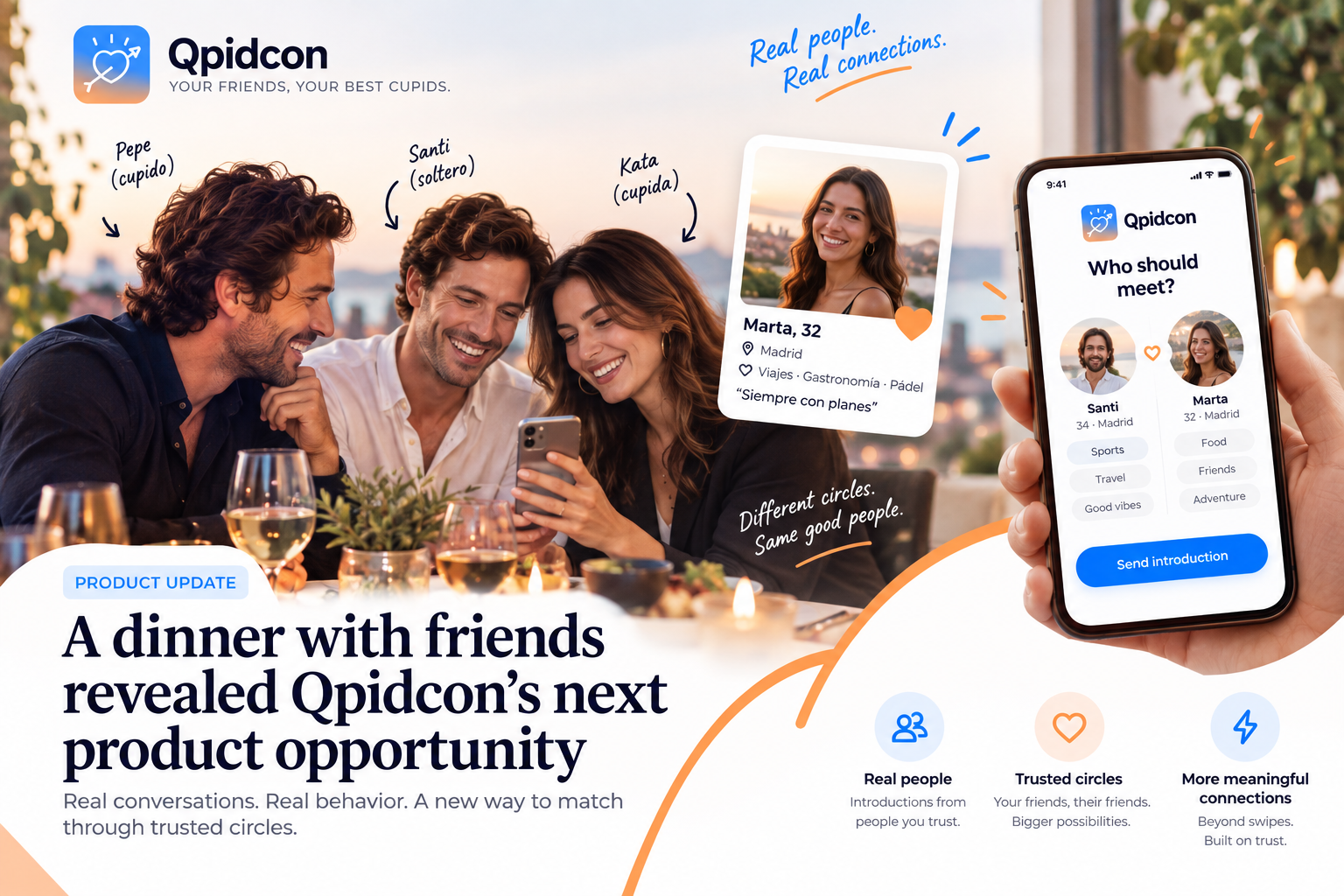
From one Cupid to two
This creates two different types of introductions inside Qpidcon.
The first is the existing model: Single ← Cupid → Single. One cupid knows both people.
The second is: Single ← Cupid ↔ Cupid → Single. Two cupids collaborate because each knows one side of the potential match.
The second model could significantly expand the number of meaningful introductions Qpidcon can create without sacrificing what makes the product different in the first place: trust.
We're not expanding the network by showing people more strangers. We're expanding it by connecting trusted circles.
The product lesson
This experience was also a reminder of something I strongly believe about product discovery. You can learn a lot from analytics, funnels, surveys and structured user interviews.
But sometimes your most valuable insight comes from watching how people naturally solve the problem your product is trying to solve. Pepe and Kata weren't using a dating app. They weren't thinking about product flows. They were simply doing what humans have been doing forever: “I know someone you should meet.”
My job as a product builder isn't to replace that behavior. It's to make it easier. That's why I'm not rushing to build the entire feature yet.
The next step is to prototype the experience and put it in front of people like Pepe and Kata:
Can they understand it without explanation?
Would they actually use it?
Does it make them think of more people they could introduce?
And, most importantly:
Does connecting two trusted circles lead to introductions that people actually want?
Where this could take Qpidcon
The bigger idea I'm exploring is that Qpidcon might not simply be a network of singles. It could become a network of trusted social circles.
Your friends know people. Their friends know other people. And somewhere across those circles there might be someone worth meeting.
Dating apps have made discovering strangers incredibly efficient.
I'm interested in exploring the opposite: Can technology make introductions through people we trust just as easy?
That's the journey we're continuing with Qpidcon.
Tus amigos, tus mejores cupidos.